
Termite Infestation & Control
Chasem Pest Control – Protecting Your Structures from Silent Destroyers
Understanding the Problem
Termites, often called the “silent destroyers,” feed on wood and cellulose-based materials, causing structural damage that often goes unnoticed until it is severe. In Kenya, both drywood termites and subterranean termites are a major threat to residential, commercial, and industrial buildings.
Risks Posed by Termites
- Structural Damage: Weakens beams, floors, and walls, leading to costly repairs.
- Economic Losses: Infestation in businesses, warehouses, and furniture outlets causes massive financial losses.
- Safety Hazards: Compromised wooden structures increase the risk of collapse.
- Difficult Detection: Termites work silently inside wood and underground, often discovered when damage is already extensive.
How Infestation Happens
- Soil Contact: Subterranean termites build mud tubes from soil to wood structures.
- Wood-in-Wood: Drywood termites infest furniture, roof trusses, and doors without needing soil contact.
- Moisture: Damp conditions create ideal breeding and feeding environments.
- Cracks & Gaps: Entry through foundation cracks, expansion joints, or untreated timber.
Types of Termites
- Workers: Smallest and most numerous; do all feeding and tunneling.
- Soldiers: Larger jaws, protect the colony.
- Queens: Long-lived, lay thousands of eggs daily.
Chasem Pest Control Solutions for Termites
- Comprehensive Inspection & Monitoring
- Identify entry points, mud tubes, and damaged wood.
- Use advanced detection tools for hidden infestations.
- Soil & Wood Treatment
- Application of insecticidal barriers in soil around foundations.
- Timber treatment with protective chemicals before and after construction.
- Fumigation (for Drywood Termites)
- Gas-tight tenting of structures to eliminate hidden colonies.
- Effective for both small houses and large complexes.
- Baiting Systems
- Strategically placed baits eliminate colonies from within.
- Environmentally safe and long-term solution.
- Preventive Proofing
- Moisture control, sealing cracks, and regular inspections.
- Advice on construction with termite-resistant materials.
Diagram – Termite Infestation & Control Cycle
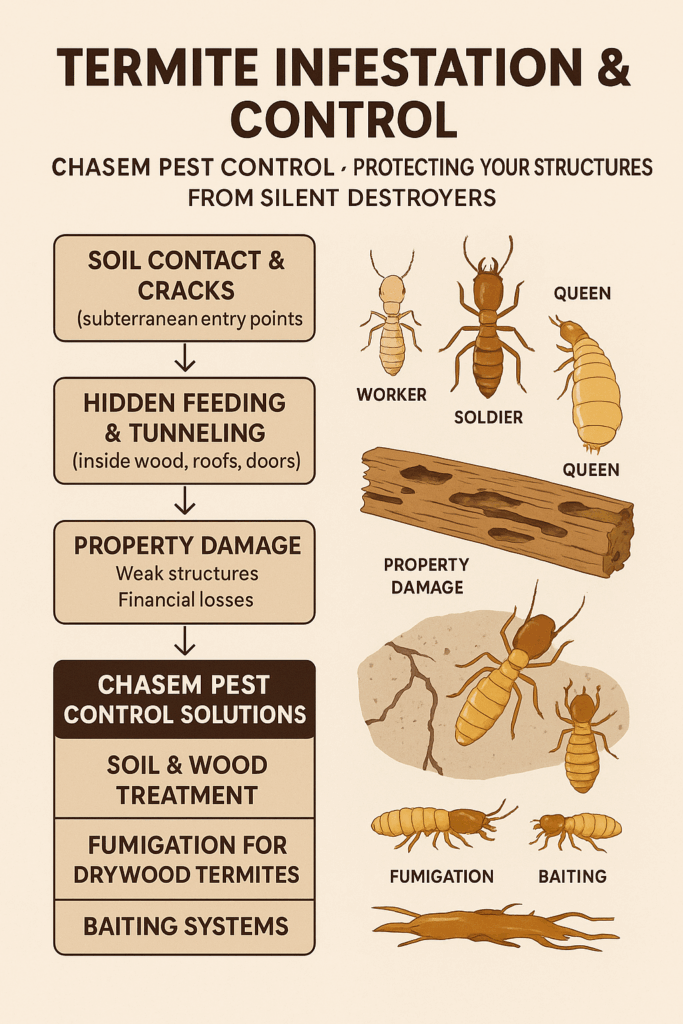
        TERMITE INFESTATION CYCLE
 ┌───────────────────────────────┐
 | Soil Contact & Cracks          |
 | (subterranean entry points)    |
 └──────────────┬────────────────┘
                ↓
 ┌───────────────────────────────┐
 | Hidden Feeding & Tunneling     |
 | (inside wood, roofs, doors)    |
 └──────────────┬────────────────┘
                ↓
 ┌───────────────────────────────┐
 | Colony Growth & Expansion      |
 | (workers, soldiers, queen)     |
 └──────────────┬────────────────┘
                ↓
 ┌───────────────────────────────┐
 | Property Damage                |
 | - Weak structures              |
 | - Financial losses             |
 └──────────────┬────────────────┘
                ↓
     CHASEM PEST CONTROL SOLUTIONS
 ┌───────────────────────────────┐
 | Soil & Wood Treatment          |
 | Fumigation for Drywood Termites|
 | Baiting Systems                |
 | Preventive Proofing            |
 └───────────────────────────────┘
Why Choose Chasem Pest Control?
- Specialized expertise in handling both subterranean and drywood termites.
- Use of modern, eco-friendly termite control technologies.
- Long-lasting protection with soil barriers, fumigation, and bait systems.
- Customized solutions for residential, commercial, and industrial needs.